When the Samiti was founded in 1976, literacy in rural Bagar was estimated below 30%. Most adults had never been to school. Children, if they went to school at all, rarely continued beyond the primary level. For girls, education beyond Class 5 was the exception, not the norm.
Today, through four decades of persistent work, that picture has changed. Literacy in the villages where the Samiti operates has risen to an estimated 75% — still below the national average, but a transformation that represents thousands of individual lives reshaped.
This is the story of how that happened.
The early years — adult literacy (1976-1985)
The Samiti's first education initiative was not aimed at children but at adults. In 1976, the founding members recognised that the literacy problem in rural Bagar was not just about the next generation — it was about the current one. Adults who could not read or write were excluded from every aspect of civic life: they could not read government forms, could not sign their names, could not help their children with homework, could not participate meaningfully in the local economy.
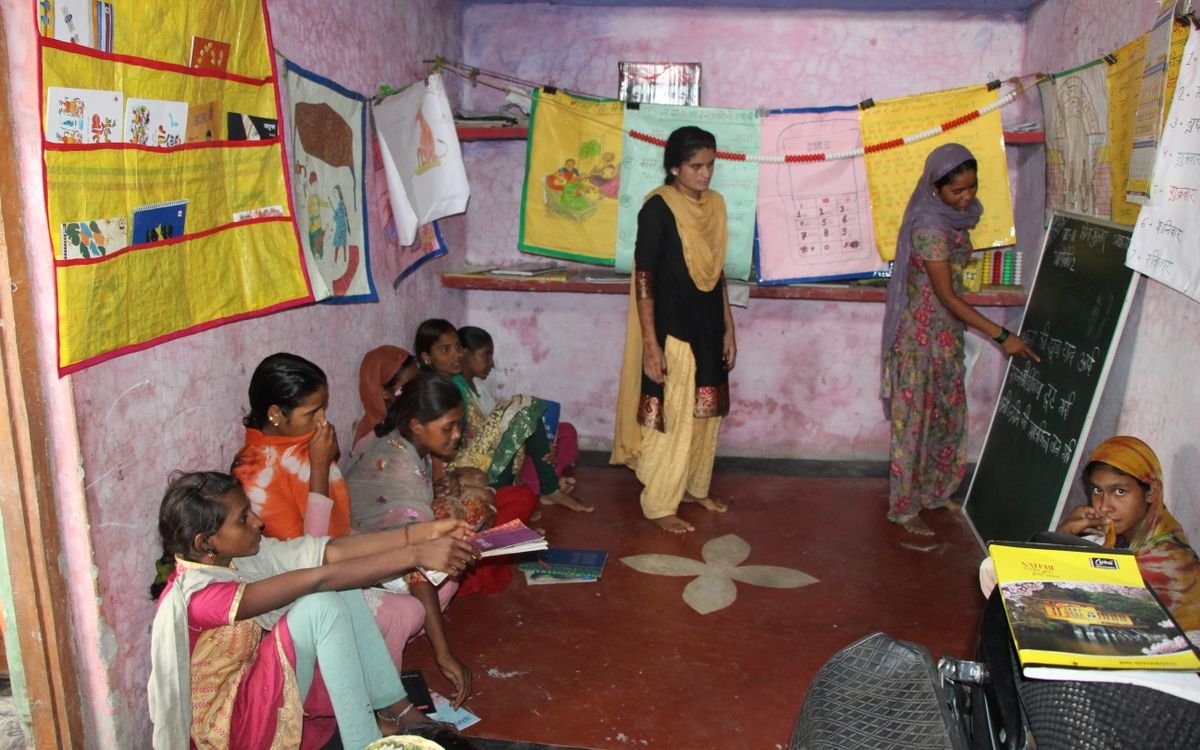
The adult literacy programme began with evening classes in Bagar, held in the Samiti's premises. Volunteers — many of them college students from Bagar who had been the first in their families to receive higher education — taught basic reading, writing, and numeracy to adults who had never held a pen.
The classes were modest in scale — 20 to 30 adults per batch — but they established a principle that has guided the Samiti's education work ever since: education is not just for children. It is for anyone who wants to learn, at any age.
The middle years — scholarships and infrastructure (1985-2000)
As the adult literacy programme continued, the Samiti began to focus on the other end of the problem: keeping children in school. The challenge was not enrolment — most children in rural Bagar did enrol in primary school — but retention. Children dropped out for many reasons:
- Financial pressure: When a family's income was insufficient, children — particularly boys — were pulled out of school to work. The loss of even a small wage was felt more immediately than the loss of future opportunity.
- Lack of supplies: Many families simply could not afford textbooks, notebooks, and uniforms. A child who turned up to school without books or in ordinary clothes felt embarrassed and was more likely to stop attending.
- Distance: Secondary schools were often several kilometres away, and without transport, the daily journey was impractical, particularly for girls.
- Early marriage: For girls, marriage — sometimes as early as 14 or 15 — cut short their education permanently.
The Samiti's response was multi-pronged. We established a scholarship programme that provided stipends to meritorious students from poor families, ensuring that the financial pressure to drop out was reduced. We created a book bank — a library of textbooks that could be borrowed for the academic year and returned, reducing the cost of supplies. And we worked with local schools to improve infrastructure, contributing towards classrooms, furniture, and basic facilities.
The recent years — partnerships and higher education (2000-present)
In the last two decades, the education programme has expanded significantly, thanks in large part to partnerships with charitable foundations and CSR donors. The partnership with Shri Sitram Jindal Foundation, which began in 2013, has been particularly transformative, allowing us to scale the scholarship programme from 80 to over 200 children annually.
A key development has been the focus on higher education. For most of the Samiti's history, the goal was simply to get children through Class 10 or Class 12. Today, we are increasingly supporting students who want to go further — to college, to vocational training, to professional courses. Several scholarship recipients are now the first in their families to hold a college degree.
The girl child — a particular focus
Throughout the programme's history, girls have been a particular focus. The reasons are simple: in rural Rajasthan, girls have historically been the most excluded from education, and the returns on educating a girl are disproportionately high. An educated girl marries later, has fewer and healthier children, is more likely to ensure her own children are educated, and contributes more to her household's economic well-being.
The Samiti has taken several specific steps to support girls' education:
- Higher scholarship stipends for girls, recognising that the barriers they face are greater
- Advocacy with families to delay marriage and keep girls in school
- Separate toilet facilities in schools we support — a critical but often overlooked factor in girls' attendance
- Mentoring programmes connecting scholarship recipients with educated women from the community who can serve as role models
The results have been encouraging. In the villages where we operate, the percentage of girls completing Class 12 has risen from approximately 20% in the 1990s to over 60% today. Early marriage, while still present, has declined significantly.
What remains to be done
Despite the progress, the challenges are far from solved. The literacy rate, while improved, still lags behind urban areas. The quality of education in rural schools remains a concern — infrastructure has improved, but teacher absenteeism and outdated teaching methods persist. Digital literacy, increasingly essential, is almost non-existent in the villages we serve.
Our priorities for the coming years include:
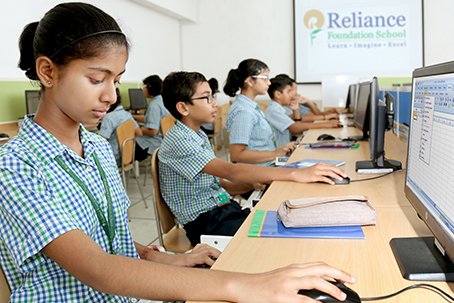
- Establishing a digital literacy centre in Bagar — basic computer and internet skills for rural students
- Expanding the higher education support programme — more scholarships for college and vocational courses
- Teacher training initiatives — working with local schools to improve teaching quality, not just infrastructure
- A dedicated girls' education campaign — targeting the villages with the lowest female literacy rates
Education is the foundation of everything else the Samiti does. A community that cannot read cannot advocate for itself. A community that cannot write cannot participate in governance. A community without education remains dependent on others — and the Samiti's mission has always been to facilitate self-sufficiency, not dependency.
If you would like to support our education programme — by sponsoring a child's education (₹5,000 per year), contributing to the book bank, or funding the digital literacy centre — please donate here or contact us to discuss how you can help.