Bagar sits in the heart of Shekhawati — a region in north-eastern Rajasthan that has been called the world's largest open-air art gallery. Every haveli wall tells a story. Every fresco is a window into a world where merchants commissioned artists to paint their walls with the same seriousness that Renaissance patrons commissioned canvases.
The frescoes of Bagar and the wider Shekhawati region, painted between roughly 1830 and 1930, represent one of the most remarkable folk art traditions in India. And yet, outside of art historians and intrepid travellers, they remain largely unknown.
The merchants who built Shekhawati
To understand the havelis, you must first understand the men who built them. The Marwari merchants of Shekhawati were among the most successful trading communities in 19th-century India. They built vast commercial networks that stretched from Calcutta to Bombay to Rangoon, dealing in opium, cotton, spices, and textiles.
But while their businesses were in the great cities of British India, their roots were in the small towns of Shekhawati — Bagar, Mandawa, Nawalgarh, Sikar, Jhunjhunu. And it was to these towns that they returned, bringing their wealth and their cosmopolitan eye, to build the homes that would announce their success to the community they had left behind.
A haveli was not just a residence. It was a statement. The more elaborate the frescoes, the more impressive the courtyard, the more ornate the jharokhas (overhanging balconies) — the greater the family's prestige. The merchants competed not just in business but in art.
The fresco tradition
The frescoes of Shekhawati were painted using a technique known as araish — a form of fresco where natural pigments are applied to wet lime plaster, allowing the colour to bond with the wall itself as it dries. The result is extraordinarily durable; many frescoes in Bagar remain vibrant after 150 years, despite having never been restored.
The pigments were all natural — mineral and vegetable sources. The deep reds came from geru (iron oxide), the blues from indigo, the yellows from turmeric and ochre, the greens from copper compounds. The plaster itself was made from slaked lime and crushed brick, giving it a smooth, almost luminous surface.
The subjects were extraordinarily diverse. Early frescoes (1830-1880) depicted mythological scenes — the Ramayana, the Mahabharata, Krishna's leelas, scenes from the lives of local deities. Later frescoes (1880-1930) began to incorporate the merchants' cosmopolitan experiences: steam trains, motor cars, aeroplanes, European figures in top hats, telephones, gramophones. Some walls show traditional gods on one side and a modern locomotive on the other — a visual record of a community straddling two worlds.
Bagar's havelis
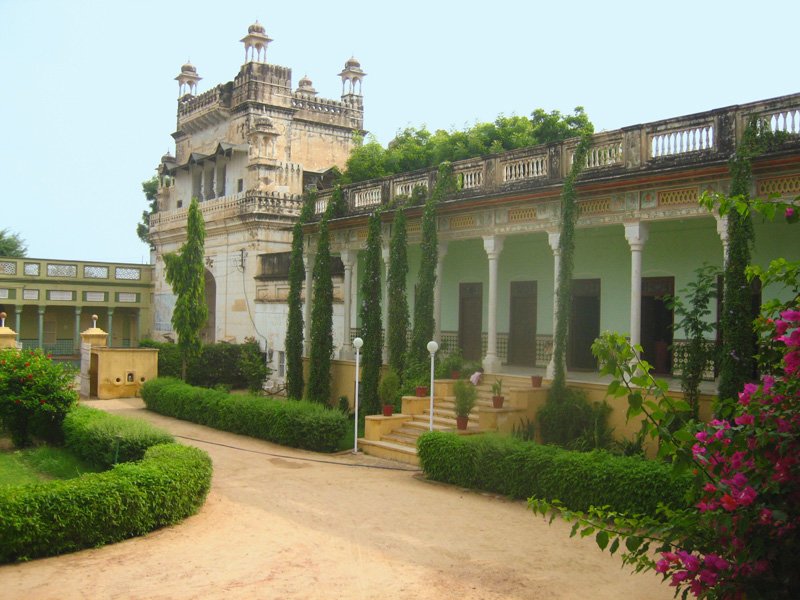
Bagar has several fine examples of the Shekhawati fresco tradition. The havelis along the main road, with their intricately painted façades and carved wooden doors, are among the best-preserved in the region. The Rungta haveli, the Daga haveli, and the Kedia haveli are particularly noteworthy for the quality and range of their frescoes.
What makes Bagar's havelis distinctive is the prevalence of a particular deep red — the madder red that dominates many of the walls. This red, derived from the root of the madder plant, has a warmth and depth that synthetic reds cannot replicate. It is the same red that gives the Shekhawati region its characteristic visual identity.
The havelis of Bagar are not just buildings. They are documents. They record a community's journey from rural Rajasthan to the trading capitals of the world, and back again. — A local historian, Bagar
The threat of time
The frescoes of Shekhawati face an existential threat. As the old merchant families have migrated to the cities — Kolkata, Mumbai, Delhi — the havelis have been left empty. Without maintenance, the lime plaster begins to crumble. Without occupants, the buildings are vulnerable to vandalism and neglect. Many of the finest frescoes in the region have already been lost.
In Bagar, several havelis have been partially restored in recent years, some converted into heritage hotels. This has been controversial — purists argue that commercial use alters the character of the buildings, while pragmatists argue that some use is better than no use, and that a heritage hotel at least maintains the building.
What is undeniable is that without active preservation, this extraordinary art will disappear within a generation. The frescoes cannot speak for themselves. They need advocates.
Our connection
Abhinav Pragati Samiti has deep roots in Bagar and the Shekhawati region. Our founder, Shri L.N. Rungta, belongs to one of the merchant families who built these havelis. The Samiti's work in education, women empowerment, and rural development is, in a sense, a continuation of the same impulse that built the havelis — the conviction that those who prosper have a responsibility to the community that nurtured them.
We believe that the heritage of Shekhawati — its frescoes, its havelis, its temples and dargahs — is not just a tourist attraction. It is the cultural identity of a region and its people. Preserving it is not nostalgia; it is self-respect.
If you are interested in visiting Bagar and exploring its heritage, read our history of Bagar and our guide to worship places. If you would like to support our work in preserving and documenting Shekhawati's heritage, please get in touch.